South London’s Roads Are Tough – Here’s How to Make Them Work in Your Favour as a Learner Driver
South London’s Roads Are Tough – Here’s How to Make Them Work in Your Favour as a Learner Driver
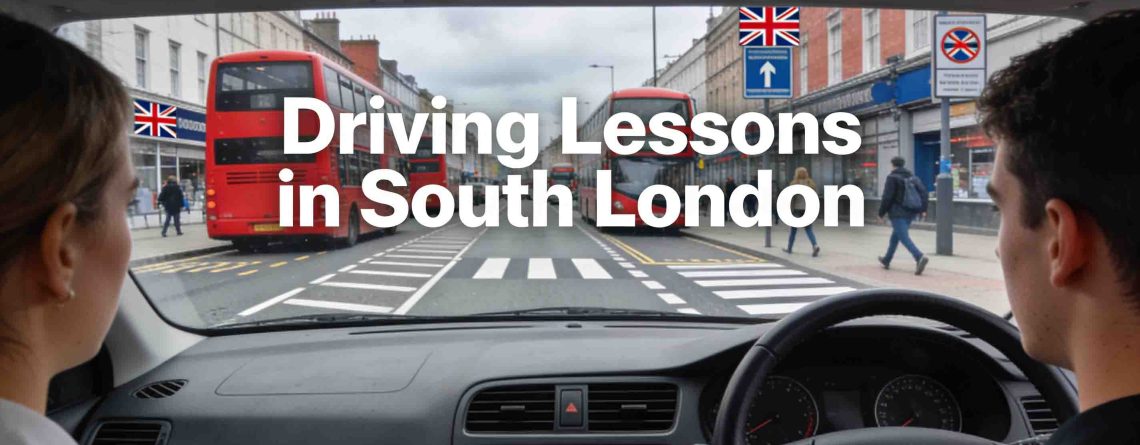
Learning to drive in South London is not the easiest path to a full licence. Anyone who tells you otherwise has probably never navigated the Elephant and Castle at rush hour, merged onto the South Circular in dense traffic, or tried to read a box junction through a windscreen full of red London buses. South London’s roads are demanding, unpredictable and relentlessly varied. But here is what most learners only discover after they have qualified: everything the DVSA practical test is looking for in 2026 is exactly what South London’s roads teach you every single lesson. Master this environment, and you can drive confidently almost anywhere in the UK for the rest of your life.
Why South London Produces Excellent Drivers
South London’s road network is effectively a full driving curriculum compressed into one of the most densely populated urban environments in Europe. Quiet residential streets in Herne Hill, Streatham and Hither Green teach low-speed precision and constant doorstep hazard awareness. The A23 Brixton Road, the A205 South Circular, the A3 and the A20 bring genuine higher-speed urban arterial driving into every lesson. Bus lanes, box junctions, zebra and pelican crossings, cycle lanes, tram crossings in Croydon, one-way systems in Lewisham, and the sheer unpredictability of London traffic mean that every single lesson covers multiple different real-world driving scenarios simultaneously.
Since November 2024, the DVSA has permanently adjusted its practical driving test format to reward exactly this kind of complex, varied driving experience. Test routes now spend more time on faster and more demanding roads, independent driving sections can run the full length of the test, and examiners are directed to include a wider range of road types than previously. For South London learners, this is not a new challenge — it is the daily reality of every lesson. The key is making sure your instructor structures your training to build on that natural exposure systematically, rather than simply driving around the same local streets week after week.
The 2026 DVSA Booking Changes: Critical Information for South London Learners
In South London, where test centres can have waiting lists stretching several months and competition for available slots is fierce, the DVSA’s 2026 booking rule changes have an outsized impact. Understanding them clearly is not optional — it is essential.
From 31 March 2026 — Maximum Two Changes Per Booking
The previous allowance of six permitted changes to a practical car test booking has been cut to just two. Every booking in the system reset to two available changes on 31 March 2026, regardless of any amendments made before that date. A change includes altering the date, the time or the test centre. Under the old system, many South London learners booked a test months in advance and shifted it repeatedly as a form of queue management. That is no longer possible. Your two changes are a finite resource — treat them as a genuine emergency reserve, not a planning tool.
From 12 May 2026 — Learners Must Book and Manage Their Own Tests
From 12 May, driving instructors are no longer permitted to access the practical car test booking portal on behalf of their pupils. Every learner in South London must have a GOV.UK account and must manage their own booking directly. Your instructor can advise you on when to book — but only you can make that booking. Set your account up now, well before you need it, and check availability in your area regularly as you approach test readiness.
From 9 June 2026 — No Long-Distance Centre Transfers
Transferring your test to a different centre is now restricted to nearby locations only. The well-known strategy of shifting a South London booking to a quieter test centre elsewhere in the country — Slough, Luton, or beyond — in search of an earlier date is no longer permitted. You must plan your test timeline around the centres realistically accessible from your home or training area.
The practical message for every South London learner is this: treat your test booking as a commitment, not a bookmark. Book when you and your instructor are genuinely confident. With two changes and no long-distance transfer option, an ill-judged booking is both stressful and expensive to recover from.
What It Costs to Learn to Drive in South London in 2026
Lesson prices in South London reflect the London cost of living and the operational complexity of teaching in a dense urban environment. In 2026, most qualified ADI instructors in South London charge between £38 and £47 per hour, with prices varying depending on the specific area, the instructor’s experience, and whether you opt for individual lessons or a block booking.
The DVSA recommends approximately 45 hours of professional tuition before the average learner is ready for their practical test. At £42 per hour over 45 hours, lesson costs alone total approximately £1,890. Adding the theory test fee (£23), the practical test fee (£62 on a weekday), revision materials and at least one mock test session, the realistic total for most South London learners falls between £2,100 and £2,700. Learners who combine professional lessons with private practice — driving with a supervising qualified driver on quieter Sunday mornings in residential areas — can meaningfully reduce the total number of paid professional hours required.
Block booking a set number of hours with your instructor upfront is the most cost-effective approach in South London. It locks in your rate against any future price increases, guarantees your weekly slot, and ensures your progress is not interrupted by availability gaps.
How the Updated 2026 Test Format Applies in South London
The permanent test format changes introduced from November 2024 are in force at every South London test centre, including Hither Green, Mitcham, Croydon, Sidcup and others serving the area. Here is how the key changes play out specifically in South London:
-
Independent driving for the full test: The sat-nav or road-sign-following section can now run for the entire approximately 40-minute practical test. In a complex urban environment like South London — where you may be navigating multiple lane changes, bus priority signals and one-way diversions while following a sat-nav route — this requires calm, systematic composure that must be practised from the very first lesson, not just the last few.
-
More time on faster roads: The A-road network — the A23, A3, A205 South Circular, A20 and A21 — will be used by examiners to fulfil the faster-road requirement of the new test format. If you have not driven confidently on these roads during your lessons, you will not be ready for the test.
-
Fewer routine stops: Three instead of four, giving examiners more route flexibility and more opportunity to use the varied South London road network during your test.
-
Emergency stops in one in seven tests: Practise the skill, understand the technique, but do not sacrifice broader road-craft development by obsessing over an exercise that now appears infrequently.
Choosing the Right Driving Instructor in South London
In a market as large and competitive as South London, the quality of driving instructors varies considerably. Choosing the right one genuinely matters. Here is what to look for:
-
Full ADI registration — always check the pink ADI certificate. Every instructor on the road must display it in the windscreen during your lesson.
-
Genuine local knowledge — your instructor should know the test routes at the centres serving your area, the junctions where learners most often make errors, and the specific road features of your local streets.
-
A structured lesson plan — not just driving around. A good South London instructor will build a clear week-by-week curriculum that develops your skills progressively across different road types.
-
Up-to-date knowledge of DVSA changes — they should be fully aware of the 2026 booking rule changes, the updated test format and the MLP consultation.
-
Honest readiness assessments — the best instructors tell you when you are not ready to test, even when you feel impatient. In South London, where wasting a test slot is both costly and difficult to recover from, that honesty is invaluable.
-
Availability during realistic traffic conditions — a lesson at 10am on a weekday teaches you very different things from a lesson at 8am or 5:30pm. Make sure your training includes the kind of traffic you will actually face on test day.
The Minimum Learning Period: South London Context
The government’s MLP consultation — exploring a mandatory gap of three or six months between the theory test and practical test, plus minimum supervised hours and a structured logbook — closed on 31 March 2026. For South London learners, who often approach driving as a practical necessity for work or family life and want to qualify as efficiently as possible, any mandatory waiting period will require earlier planning than has historically been the norm.
The best preparation is to start now. Begin your lessons with a clear plan, document your progress and the road types you are covering, and treat your driving education as a proper curriculum rather than an accelerated sprint to the test. Whether or not the MLP becomes law, this approach builds a genuinely capable driver — and in South London’s traffic, genuine capability is what keeps you safe.
Digital Driving Licences: A Perfect Fit for South London’s Young Drivers
The GOV.UK Wallet digital driving licence — rolling out through 2026 and 2027 — is a natural fit for South London’s large population of young professionals and students who already manage transport, payments and identity entirely through their smartphones. Newly qualified drivers in South London will be able to prove their identity and entitlement to drive directly from their phone. Physical licences remain fully valid and will continue to be issued alongside the digital option.
Seven Tips for Passing Your Driving Test in South London
-
Embrace the traffic, do not fear it. Every complex junction you navigate during a lesson is a rehearsal for your test. South London traffic is your most powerful teacher.
-
Practise sat-nav following on every single lesson. Independent driving can now run the entire test in a dense, complex environment. This skill requires consistent, calm practice — not a crash course in the final fortnight.
-
Get onto the A-road network regularly. The A23, A3 and South Circular are essential preparation for the faster-road requirement of the updated test format.
-
Set up your GOV.UK account immediately and learn how to use the test booking system before you need it under pressure.
-
Only book your test when your instructor confirms you are genuinely ready. With only two changes permitted from March 2026, a premature booking is a costly mistake in South London’s competitive test environment.
-
Request peak-hour lessons. South London at rush hour is difficult — but it is also exactly what the DVSA test expects you to manage. Do not avoid it.
-
Consider a block booking. It locks in your rate, maintains consistency, and ensures you are not scrambling to find available slots as your test date approaches.
Book Your Driving Lessons in South London Today
At Driving Lessons 4 All, we have ADI-registered instructors covering South London who understand these roads, these test centres and these 2026 DVSA changes inside out. Whether you are a complete beginner, a returner, or someone who has previously failed their test and wants a fresh start, we will build you a lesson plan that develops real skills and real confidence. Get in touch today to book your first lesson.